The trust overload paradox: how doing everything right makes AI trust you less
Updated:
Quick answer: piling trust signals onto a page drops a challenger brand's chance of breaking into an AI recommendation from 55% to 21.2%. That figure comes from research on brand bias in language model recommendations, and it inverts the standard optimisation instinct. More badges, more quotes, more schema and more certifications do not add up. Past a point they subtract.
Which finding breaks the checklist?
Optimisation advice is additive by nature. Every guide lists signals that correlate with visibility, and the implied instruction is to collect as many as possible. Add the reviews. Add the certifications. Add the author block, the schema, the trust badges, the testimonials.
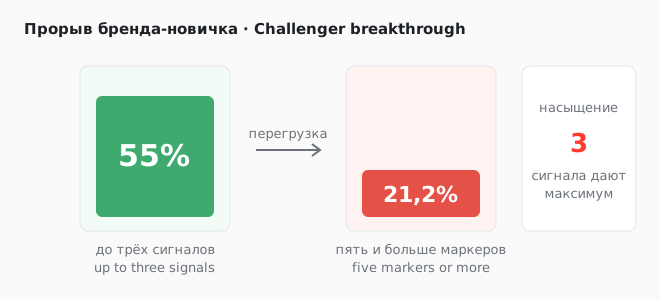
The research on incumbent advantage in model recommendations tested what happens when a brand does exactly that. A challenger brand, meaning one the model does not already know, sees its breakthrough rate fall from 55% to 21.2% under trust-signal overload.
The mechanism is not mysterious. A page carrying an unusual concentration of credibility markers looks like a page that needs them. Established brands do not plaster their pages with badges, because their name already does that work. The overload pattern correlates, in training data, with the sites that had something to compensate for.
The model is not judging your intent. It is recognising a shape.
- Persuasion marker
- An element whose job is to produce trust rather than report a fact: a badge, an award, a review without a source.
- Challenger brand
- A brand with no accumulated recognition, one the model does not know before it reads the page.
Why is this worse for small businesses specifically?
The finding lands hardest on exactly the businesses that follow advice most diligently.
A known brand can add trust signals with little downside, because the model already has a prior about them. Their name carries recognition that survives whatever is on the page.
An unknown brand has no such prior. The page is all the model has. And an unknown brand doing everything the checklist says produces the exact pattern the research identifies as suspicious.
This is the uncomfortable structure of the whole field: the optimisation advice that circulates most widely is safest for those who need it least.
What did we change in our own engine?
We build an auditing tool, which means this finding was aimed at us as much as at anyone. Two changes came out of it.
Saturation instead of accumulation. Trust signals are no longer counted linearly. The score uses min(1, n/3): the first three signals carry full weight, the fourth and beyond add nothing at all. A site with twelve trust markers scores exactly the same as a site with three.
We chose three because the research points at pile-up rather than presence as the problem, and because three is roughly where a page stops looking bare and starts looking normal. That threshold is our judgement, not a measured cut-off, and it is worth stating plainly.
An over-optimisation flag. The engine now watches for a specific combination: five or more persuasion markers on a page whose body text is thin and which carries no original images. When that pattern appears, the score takes a penalty proportional to how thin the content is.
The flag is not a fraud detector. It is a shape detector, and the shape it detects is "page built to pass a checklist rather than to inform anyone".
What counts as a persuasion marker?
Our engine watches six, and any five together on thin content trigger the flag:
- an attributed expert quote
- high density of numerical statistics
- outbound links to primary sources
- visible reviews or ratings
- a full set of trust signals such as address, phone, licences and policies
sameAslinks connecting the site to external profiles
Every one of these is a good thing on its own. Each is recommended, and we recommend them ourselves in other articles. The problem is not any single marker. The problem is all of them arriving at once on a page that has nothing else.
Which rule comes out of this?
Trust signals should be the residue of a real business, not a layer applied to a page.
A company that has been operating for a decade has reviews because customers left them, has certifications because it earned them, has an address because it occupies one, and has an expert quote because someone there knows something. Those signals appear naturally and unevenly. Some are strong, some are missing, and that unevenness is itself the pattern of authenticity.
A page assembled from a checklist has all of them, uniformly, and none of them connected to anything. That is the shape that gets discounted.
The practical instruction is unglamorous: add the signals you actually have, do not manufacture the ones you do not, and put your effort into the body of the page instead.
A modern model reasons. When it sees a site stuffed with trust badges taken straight off a checklist, it draws the conclusion a person would draw: this was built for an algorithm, not for people. An excess of signals becomes a signal itself, only the opposite one.
Where does the paradox not apply?
Two limits are worth stating, because this finding is easy to over-read.
It applies to challengers, not to everyone. The measured collapse was for brands the model did not already know. If your brand is established, the effect is weaker.
It is about concentration on thin content, not about quality. A three-thousand-word article that happens to contain a quote, statistics and outbound sources is not overloaded. It is well sourced. The penalty in our engine scales with thinness for this reason: the same markers on substantial content trigger nothing.
The failure mode is a short page trying to look authoritative. The safe mode is a substantial page that happens to be authoritative.
What do our own pages look like under this rule?
We scanned five pages of our own site on 27 August 2026. None of them trip the over-optimisation flag, and the reason is not restraint. It is absence.
| Page | Content score | Expert quote | Statistics | Trust signals |
|---|---|---|---|---|
| Pricing | 66% | no | partial | yes |
| Home | 63% | no | no | yes |
| Services | 55% | no | no | yes |
| Contacts | 55% | no | no | yes |
| Blog index | 53% | no | no | yes |
Not a single attributed quote across five pages. Statistics only where prices forced them. Trust signals present, because address and phone are simply facts about a company that exists.
That is the opposite failure from the one this article warns about, and it is far more common. Most sites are not overloaded. Most sites are empty, with a trust layer sitting on top of nothing in particular.
The overload paradox is real, but it describes a ceiling, not the average condition. The average condition is a page with three trust badges, no quote, no figures and eight hundred words of description. That page is not penalised for trying too hard. It is ignored for having nothing to lift.
Worth stating plainly, since we are the ones publishing this: the fix on our own pages is to add one or two genuine quotes and the numbers we already have, not to remove anything. We are nowhere near the ceiling.
How do you tell overload from substance in one pass?
A quick heuristic that costs nothing:
Count the words that are not persuasion. Strip out the badges, the testimonial carousel, the certification row, the schema block. Count what remains as prose that teaches the reader something. If that number is under five hundred words on a page carrying five trust markers, you are in the flagged zone.
Check whether the signals point outward. Real trust signals reference something checkable: a licence number, a profile on an external platform, a named person, a physical address. Decorative ones reference nothing. A badge that says "Trusted" with no issuer behind it is a graphic, not a signal.
Ask whether the signals are uneven. A genuine business has strong marks in some places and gaps in others. Uniform coverage across every category is the fingerprint of a checklist, and that uniformity is itself the tell.
Frequently asked questions
Should I remove trust badges from my site? Not if they are real and relevant. Remove the ones that are decoration, and stop adding new ones on the assumption that more is better. Past three the marginal value in our model is zero.
Does this contradict the advice to add expert quotes and statistics? No, it bounds it. One or two quotes and a page built on real figures is the shape that works. The same elements crammed onto a nine-hundred-word page with stock photos is the shape that fails.
How do I know if my page is overloaded? Ask what the page would look like with the trust elements removed. If a substantial, useful page remains, you are fine. If what remains is a stub, the trust layer was carrying the page.
Does this apply to Google as well? Differently. Classical search has its own spam signals, and stuffed pages have never done well there either. The specific mechanism measured here is about model recommendations, not rankings.
What about review counts on a legitimate business with thousands of reviews? Genuine reviews on a page with real content are not the pattern in question. The research measured artificial concentration on pages without substance.
Is three trust signals really the right number? It is our threshold, derived from the direction of the research rather than from a measured cut-off. We state it as a project decision because pretending otherwise would be the same overclaiming the article warns about.
The short version
The instinct that more optimisation is better breaks down at a measurable point. For a brand the model does not know, stacking credibility markers cuts the chance of breaking through by more than half.
What survives is boring and hard to sell as a service: have a real business, state what you actually know, show the signals you actually earned, and spend the rest of your effort on the content itself. Optimisation is what happens after there is something to optimise.
Sources: "Incumbent Advantage: Brand Bias and Cognitive Manipulation Dynamics in LLM Recommendation Systems" (arXiv, 2026); GEO-bench measurements (Princeton University); project research digest compiled from 165 sources on AI search, August
- Details in
sources/research-notes.md.